
Banana chips are a popular snack in many countries because they are crispy, flavorful, easy to package, and have a relatively long shelf life. For banana growers, food processors, and entrepreneurs, turning fresh bananas into banana chips can create an opportunity to add value to raw agricultural products.
But how do you turn fresh bananas into a commercial banana chips business? The key is to choose the right raw materials, establish an efficient production process, and select banana chips processing equipment that matches your production capacity.
1. Choose the Right Bananas
The quality of the final banana chips starts with the raw bananas.
For commercial production, bananas should generally be fresh, firm, and at a suitable maturity level. Overripe bananas can be difficult to peel and slice consistently, while bananas that are too unripe may affect the flavor and texture of the finished chips.
When selecting bananas, consider:
- Banana variety and size
- Maturity and firmness
- Freshness
- Absence of bruises or damaged areas
- Consistent raw material quality
A stable supply of suitable bananas is especially important when operating a continuous production line.
2. Understand the Banana Chips Production Process
A commercial banana chips production line usually includes several processing steps. The exact configuration can be adjusted according to the banana variety, desired product, production capacity, and final product requirements.
A typical process is:
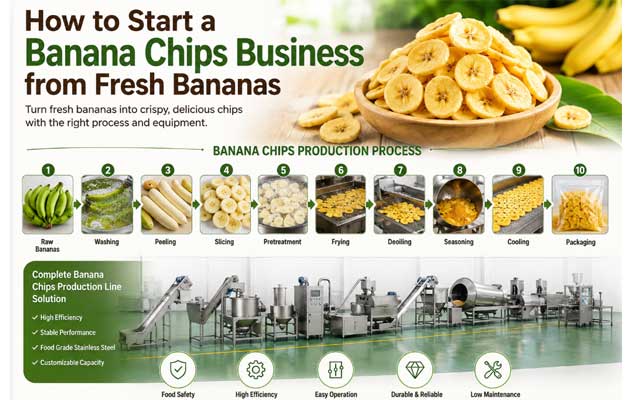
Fresh Bananas → Washing → Peeling → Slicing → Pretreatment → Frying → Deoiling → Seasoning → Cooling → Packaging
Each stage plays an important role in maintaining product quality and production efficiency.
3. Wash and Prepare the Bananas
Fresh bananas may contain soil, dust, and other impurities from harvesting and transportation. A commercial washing machine can help clean the raw materials before further processing.
After washing, the bananas are peeled and prepared for slicing. For larger production capacities, mechanized peeling and conveying systems can help reduce manual labor and improve processing efficiency.
4. Slice Bananas into Uniform Pieces
Uniform slicing is essential for producing banana chips with a consistent appearance and texture.
A banana slicing machine can cut bananas into relatively uniform slices at a controlled thickness. The slicing thickness can be adjusted according to the desired product style.
Consistent slices also help improve subsequent frying because pieces with similar thickness tend to cook more evenly.
5. Pretreat the Banana Slices
Depending on the product requirements, banana slices may undergo pretreatment before frying.
Pretreatment can help control characteristics such as color, flavor, and texture. The specific method should be selected according to the banana variety and the desired finished product.
For commercial production, the pretreatment process can be integrated into the overall banana chips processing line to improve consistency.
6. Fry the Banana Slices
Frying is one of the most important stages in banana chips production.
An industrial frying machine provides more consistent control of frying conditions than manual frying. Parameters such as temperature, frying time, oil circulation, and product throughput can be controlled according to the production requirements.
A suitable frying system can help produce banana chips with:
- Consistent color
- Crispy texture
- Uniform frying
- Stable production quality
- Better production efficiency
For larger factories, continuous frying systems are often considered to improve production capacity and reduce manual operation.
7. Remove Excess Oil
After frying, the banana chips may contain excess surface oil. A deoiling machine can help remove excess oil before seasoning and packaging.
Effective oil removal can improve the eating quality of the finished product and help control oil consumption during production.
The deoiling stage can also make the subsequent seasoning process more consistent.
8. Add Seasoning and Cool the Chips
After deoiling, banana chips can be seasoned according to the target market.
Common flavor options include:
- Original
- Salted
- Sweet
- Spicy
- Barbecue
- Other customized flavors
A seasoning machine can help distribute seasoning more evenly across the product.
After seasoning, the banana chips should be cooled before packaging. Proper cooling helps prevent condensation inside the package and supports better product quality.
9. Choose the Right Banana Chips Processing Equipment
The equipment configuration should depend on your production goals rather than simply choosing the largest machine available.
For a small business, a semi-automatic or compact banana chips production line may be sufficient. For larger factories, a fully automatic line can integrate multiple processing stages and reduce labor requirements.
Important factors to consider include:
Production Capacity
Determine how many kilograms or tons of bananas you need to process per hour or per day.
Automation Level
Consider how much manual labor is required at each stage and whether automatic conveying, slicing, frying, deoiling, seasoning, and packaging are needed.
Product Requirements
Different banana chip products may require different slicing thicknesses, pretreatment methods, frying systems, and seasoning configurations.
Factory Space
The equipment layout should allow smooth material flow from raw banana handling to finished-product packaging.
Future Expansion
If you expect your business to grow, consider equipment that allows additional processing capacity or packaging options to be added later.
10. Consider a Complete Banana Chips Production Line
Instead of purchasing individual machines separately, businesses with larger production requirements can consider a complete banana chips processing line.
A complete solution can integrate:
Banana Washing → Peeling → Slicing → Pretreatment → Frying → Deoiling → Seasoning → Cooling → Packaging
This approach can simplify material transfer between processing stages, reduce manual handling, improve production efficiency, and make the entire production process easier to manage.
The line can also be customized according to production capacity and factory requirements.
11. Plan Your Banana Chips Business Before Buying Equipment
Before investing in a banana chips production line, it is important to define your business requirements.
Consider these questions:
- How many bananas can you source every day?
- What production capacity do you need?
- What type of banana chips do you want to produce?
- What package sizes will you sell?
- Which markets will you target?
- How much factory space is available?
- How much automation do you need?
- Do you need an integrated packaging system?
Answering these questions first will make it easier to select suitable banana chips processing equipment.
12. Turn Fresh Bananas into a Value-Added Product
Starting a banana chips business is not simply about buying a machine. A successful production project requires the right combination of raw materials, processing technology, equipment configuration, quality control, packaging, and market positioning.
For entrepreneurs and food manufacturers with a reliable supply of fresh bananas, a well-designed banana chips production line can help transform fresh agricultural products into a convenient, value-added snack.
If you are planning a banana chips factory, the production line can be customized according to your raw banana supply, required capacity, product specifications, factory space, and automation requirements. Choosing the right equipment configuration at the beginning can help create a more efficient and scalable production system.